Prior Authorization & CMS-0057 Compliance
A healthcare intelligence platform built to tackle the complexity of prior authorization - from policy ingestion through decision, denial, appeal, and reporting.
The prior authorization problem
Prior authorization is one of the most operationally complex and resource-intensive processes in healthcare. With CMS-0057 now in effect, the bar has risen: payers must meet strict turnaround times, deliver specific denial reasons, and stand up FHIR-based APIs - all while managing fragmented data and constantly changing policies.
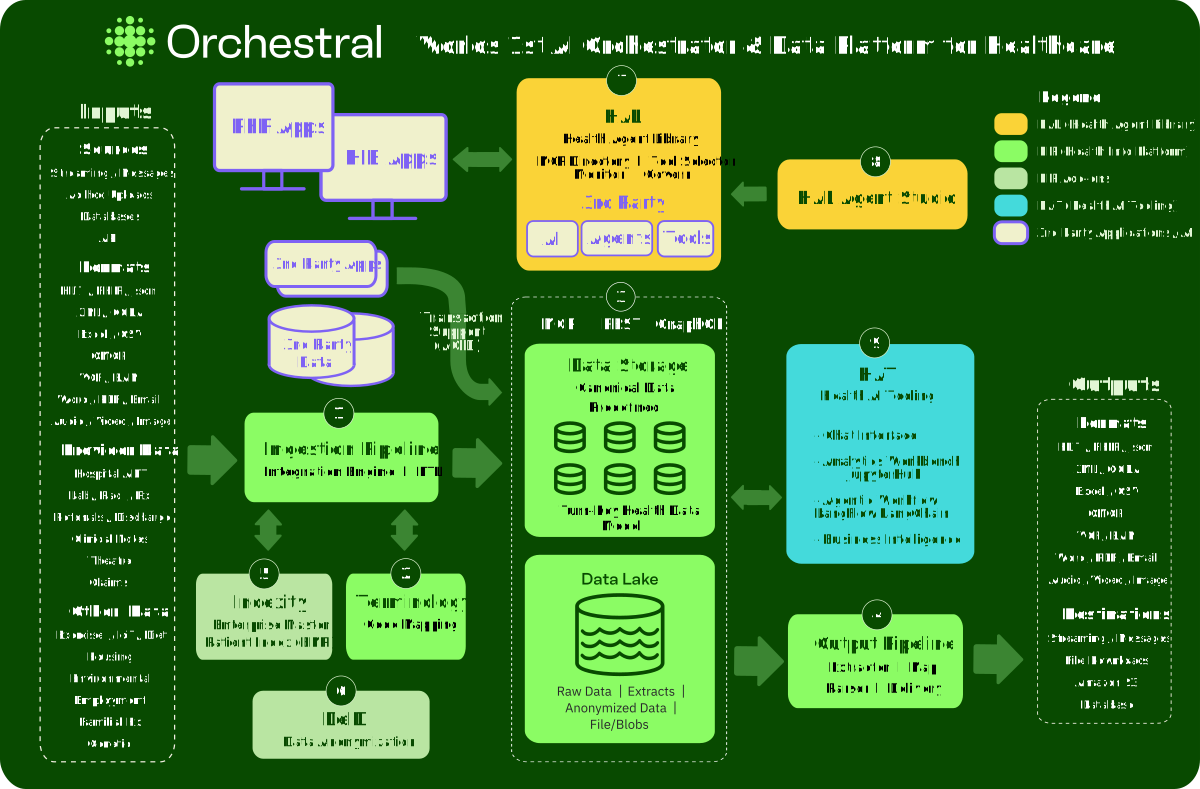
Orchestral’s healthcare intelligence stack - the Health Information Platform (HIP), Health AI Library (HAL), and Health AI Tooling (HAT) - provides the foundation to build and deploy PA solutions to meet these needs.
What the platform enables
| Challenge | Platform capability | How it works |
|---|---|---|
| Policies trapped in PDFs | AI Design + HIP | NLP and knowledge graphs extract coverage rules from unstructured documents into machine-executable logic. |
| Clinical-to-billing code gaps | HAL + HAT | Semantic matching translates SNOMED/LOINC to CPT/HCPCS with clinical context. |
| Generic denial codes | AI runtime | LLMs grounded in policy generate patient-specific, audit-ready denial rationales. |
| Brittle auto-adjudication | AI runtime + monitoring | ML scoring auto-approves clear cases, routes complex ones to human review. |
| Siloed data systems | HIP data pipelines | Ingest from claims, clinical, UM, and identity systems into a unified FHIR-ready layer. |
| Policies change constantly | HIP + monitoring | Change detection, versioned policy stores, and automated re-validation workflows. |
For payers
Policy rule ingestion - Parse medical policies via NLP and knowledge graphs into coverage determination APIs.
Intelligent auto-adjudication - ML scoring to triage PA requests. Clear cases auto-approve; complex cases route to reviewers with full context.
Compliant denial generation - AI-generated specific, clinically grounded denial explanations that satisfy CMS-0057 and withstand appeals.
FHIR API suite - Patient access, provider access, prior authorization, and payer-to-payer APIs built on HIP’s data layer.
Metrics & reporting - PA performance metrics for CMS submissions and public transparency requirements.
For providers
Clinical evidence extraction - NLP to pull, normalize, and codify evidence from EMR/HIE into submission-ready FHIR formats.
Auto-generated EDI 278 - Rules engine plus AI to compose complete, evidence-backed submissions that cut first-pass denials.
Predictive denial risk - ML models that surface denial probability at order entry, with decision support to strengthen documentation or choose alternatives.
Appeals & patient comms - Auto-drafted appeal letters and plain-language PA status updates for patients.
Industry impact
Why now: CMS-0057 deadlines
The CMS Interoperability and Prior Authorization Final Rule (CMS-0057-F) imposes binding requirements on Medicare Advantage, Medicaid/CHIP, managed care plans, and QHP issuers. Providers in MIPS must also comply. Three deadlines are already in motion:
Jan 1, 2026 (in effect) - 72-hour urgent / 7-day standard PA turnaround. Specific denial reasons required. API metrics reporting begins.
Mar 31, 2026 - First public PA metrics due: approval/denial rates, decision times, appeals outcomes.
Jan 1, 2027 - Four FHIR-based APIs live in production. Non-compliance impacts payments and Star Ratings.
What the rule requires
Payers must:
Build and maintain four FHIR APIs: patient access, provider access, prior authorization, and payer-to-payer.
Return PA decisions within 72 hours (urgent) or 7 calendar days (standard).
Provide specific, clinically grounded denial reasons - not generic codes.
Report Patient Access API usage metrics to CMS annually.
Publish PA performance metrics publicly each year (first due March 31, 2026).
Providers must:
Submit at least one electronic PA request per year (MIPS requirement).
Integrate EHR systems with FHIR-based PA workflows (CRD, DTR, PAS).
Package clinical evidence in structured FHIR formats for electronic submission.
Why Orchestral
Healthcare-native - Built from 30 years of healthcare infrastructure. Not a general-purpose cloud tool adapted for healthcare.
Unified stack - HIP, HAL, and HAT work as one ecosystem. Data, AI, and orchestration are integrated - not bolted together.
Tailored to your workflows - We work with your team to scope, configure, and deploy PA capabilities that fit your existing systems and processes.
Deploy incrementally - Modular architecture means you can start with the highest-impact capability and expand from there.
National scale - Proven at statewide Health Data Utility scale. From a single plan to a state Medicaid program.
The January 2026 requirements are already in effect.
January 2027 API mandates are less than 12 months away. Every month of delay compounds cost and risk.
Talk to our team about your CMS-0057 readiness and where Orchestral’s platform can help.